Cosmos:
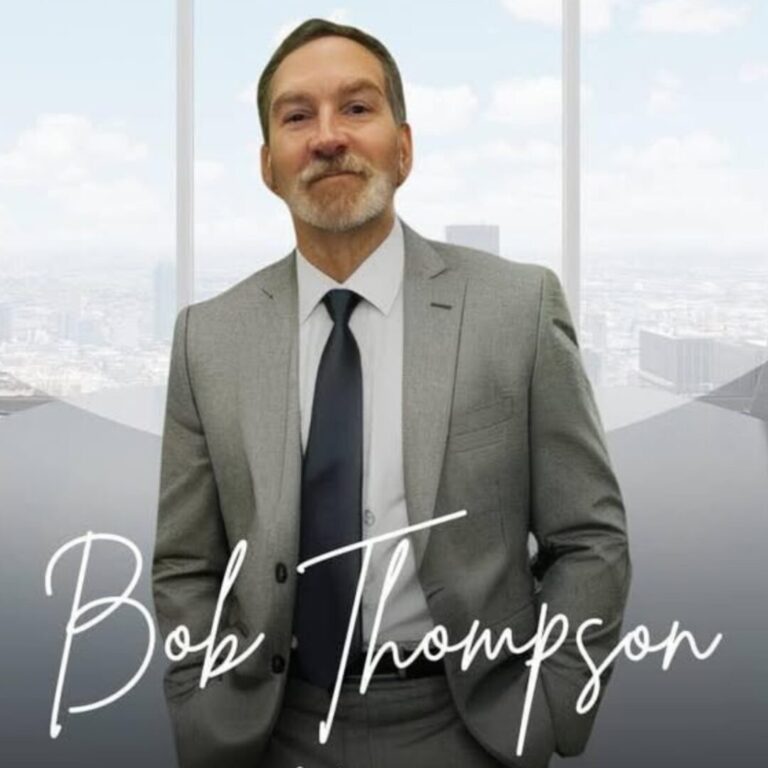
Welcome back to the show, my fellow extraordinary Americans. Today’s guest is Bob Thompson. Bob is a motivational speaker, a seasoned life coach, and a celebrated real estate expert who began his real estate career at the age of 35. He has also worked with industry vanguards such as zone.com and VHDA. After navigating two heart attacks and a challenging bypass surgery, he came back stronger than ever.
As a motivational speaker and life coach, Bob transmutes his life lessons into profound teachings. He infuses his real estate wisdom to highlight universal tenets such as patience, diligence, visionary thinking, and leveraging past setbacks for future growth. He’s an extraordinary American, and I’m glad to have him on the show. Bob, it’s so good to have you here.
Bob Thompson:
Well, thank you. And that was an excellent introduction, and you made me sound really good. I appreciate it.
Cosmos:
I appreciate you, too, Bob.
Bob, can you tell me a little bit more about yourself, your background, and your story, and how you got to where you are?
Bob Thompson:
Yeah, no problem. Essentially, I’m one of those people who kind of just floundered around and did absolutely nothing constructive. In my mid-to-late 20s, I was basically doing my own thing. I got a job at a chemical plant, worked my way into the lab, and became a chemist for nine years.
And in approximately 2003, I began researching the purchase of rental properties. I quickly discovered that I was a terrible landlord because I was too nice. But I enjoyed the hunt for the real estate itself, looking for properties. At that point, I obtained my real estate license and started working in real estate part-time.
And then I made a conscious decision in 2005 that I needed to exit the chemical plant completely. I just wasn’t happy. I was making decent money, but at the same time, I was working 12-hour shifts. I’ve got 15 bosses. I’m just miserable. I’m not happy.
So, my ex-wife and I put a three-year plan together, and we completed it in two years. I walked out of that chemical plant in April 2007, in the midst of the recession and everything else, and never looked back. I’m quite happy I did it.
Cosmos:
Bob, I knew you got into real estate after spending some time as a chemist. So, how did that go about? What was your vision for your life at that point that led you to the real estate industry?
Bob Thompson:
So basically, what happened is I, of course, got the job at the plant, and then I was one of the last hires where I was able to work my way into the plant without a degree.
So at this point, I’m a chemist in name, indeed, without a chemical degree. I actually started going back to school. I’m sitting in freshman chemistry. I’m about 31 years old at this point, surrounded by 22-year-olds. We’re literally talking freshman chemistry. I’ve got my own lab coat with my name on it, all of my own supplies, and we’re using a Bunsen burner and burning cork. And I just like the light bulb went off. I thought, ‘I cannot do this for the rest of my life.’ I am done. Like, I just made a decision. This is not where I want to be. It’s what I thought I wanted to be. And they were paying for school, but it just didn’t work.
At that point, I realized I needed to find something else I could do to make a living. And I wasn’t going to go back to, you know, back to the grocery store or do some other manual job. It was like, I’ve got to find something better. And that’s kind of what led me on that journey of jumping into real estate and, of course, buying rental property because I had good credit.
And then from there it became, well, I love the hunt. I love the high of the transaction, the negotiation, all of the stuff that, that really, even to this day, 20 plus years later, gets me going. And it just snowballed from there; it was like, ‘You know what? We put a plan together and we accomplished that plan.’ But that really was. The spark is sitting in that classroom, just, you know, out of control.
Cosmos:
Wow.
Bob, during your time in your real estate career, what are the lessons you gleaned that you think apply to life in general from that time?
Bob Thompson: I would say, without a doubt, the biggest thing is you just have to keep moving forward. You never know what will happen. Real estate is interesting because there is no plan. In other words, when I worked at the grocery store, I knew that if I did X, Y, and Z, I would be the assistant manager of a department within six months.
And then if I did X, Y, and Z, I could move into management. With real estate, it doesn’t exist. There is almost a blind faith in what you’re doing. Much like anybody running
Bob Thompson: A business or an aspiring entrepreneur, you just have to have faith that if you keep moving forward and keep doing what you’re supposed to be doing, that you will succeed. At the end of the day, it’s a weird thing, but it’s. It’s kind of. It’s got to be done.
And I think it separates entrepreneurs from the average 9-to-5. And I think it’s the hardest thing. One of the hardest things for nine-to-five people to figure out when they become entrepreneurs is that there are no set hurdles in the way. You’ve just got to keep moving forward.
Cosmos:
Yeah, I, I’ve noticed like, sometimes a lot of times people, they, they’re going at it for quite some time and then they just give up right before.
Right before success hits, and they don’t know how close they were to success, until, like, they see it in hindsight.
Bob Thompson:
Yeah, and it’s easy to do. I mean, especially, you know, one of the things I talk about is the fact that, you know, you’re almost better off working in the dark, which basically means we are surrounded by negativity.
And if we tell everybody our dreams, we’ll always find a few people who will try to tell us that we’re wrong. It can’t happen. What are you doing? And I learned that from my own experiences, even from going from the grocery store to the chemical plant and then leaving the chemist job, you know, in the middle of a recession in 2007, where everybody just thought I was crazy.
And they’re like, What are you doing? You have a job, you have good benefits, but you’re never going to make it in real estate; you’re never going to be successful. You’re making a mistake. And I learned from that, which is, quite honestly, don’t tell anybody else your business other than your closest people, because there’s always going to be somebody that’s going to try to be negative and tear you down, unfortunately.
Cosmos:
Bob, I’ve actually interviewed a lot of guests who, who actually told me on the show that they’re sometimes their closest friends or their own family members who had been negative, like for their dreams and aspirations, and try to stop them from doing what they wanted. But they overcame that regardless.
But that’s something that I find with a lot of people, that their own family would do, would do that.
Bob Thompson:
Yeah, I think it happens quite often. And I think that’s a combination of maybe that family member’s background. And let’s be honest, some people are just negative; they just are. Love them to death. We all have people in our family or circle that I compare to Eeyore from Winnie the Pooh. They’re just always kind of negative. They’re never really happy, you know, and some of that is maybe personal stuff going on in their world. Some of that is just the way they were raised or taught, or whatever.
But there will always be people like that. Another problem is that you have the person who thinks they’re an expert in everything. You know, we all know that one person who really hasn’t accomplished a whole lot, but, you know, they know everything about computers, cars, real estate, raising kids, anything going on in the world. They are the expert and they know it all. And those people will drag you down very quickly. If you take anything that comes out of their mouth at face value, you will fail.
So you just kind of have to. Like I said, I tend to. And what I coach is that you don’t need to tell everybody your business, you know, that doesn’t do any good. And you’re not. And who are you trying to convince, them or yourself?
Cosmos:
No, I mean, totally. Also, I would like to add that I’ve noticed that, like many times when people are negative, it’s not actually that they’re being negative towards you. They’re just projecting their own sufferings onto their own life, and they’re looking for an outlet, and you just happen to be on the receiving end of that.
And many people take negativity personally. But I would say that you should not do that, you know?
Bob Thompson:
No, definitely not. And some people are irritated or mad at themselves because they’re not in a position to. Where they are, they’re either able to go kind of and do their own thing, or quite honestly, they don’t have the intestinal fortitude or whatever to take a chance.
So they may have a dream of doing something, but they’re not willing to take that opportunity and move toward that direction. They would rather just stick with the day job and be miserable for the next 40 years, which is fine. We all have bills to pay, and you have kids, so you have to do what you have to do.
However, in our modern world, it’s a lot easier to walk away from something. It’s a lot easier to build a quote unquote side hustle and then turn it into your main hustle as opposed to when my father was working at the GE plant for 19 years, you know, where he didn’t, he had to get up and do that nine to five because he had to, you know, take care of the kids and you know, pay the bills and the benefits and all the stuff that comes with that. It’s not as if he could simply jump on the Internet and find a job elsewhere or do anything else. You’re talking, you know, newspapers, and you just stuck to what you knew best. And that’s just the way it went.
Cosmos:
So Bob, I had a question, regarding like the 2007,
The 2008 era of your life. As you can see, it was obviously a very challenging time, especially regarding real estate.
What was your mindset, and what was going on in your mind as you went about overcoming this time?
Bob Thompson:
So the biggest thing for us was we realized that if we didn’t have any debt, then we would be okay. So, basically, when we started this process, my wife and I each had a car payment. We had all of the trappings that come with that.
So, the decision was made that if we paid off all our debt, then even if I failed or even if I only made, let’s say, $20,000, she would have a job. So, we knew we would at least be able to make the minimum payments, which include the mortgage on the house, the cable bill, the phone payment, and the other expenses that come with it, such as insurance and other related costs. We wouldn’t have been living well if I had failed, but we also wouldn’t be out of the house. So that was the biggest thing. Often, people want to leave their job, but they also have a ton of debt, and those two things don’t go hand in hand.
So, we made a conscious decision to put any extra money coming in from my part-time real estate work towards paying off the bills. So, when I left the chemical plant in April 2007, we had absolutely no debt whatsoever. We had a mortgage payment and our regular bills, but all of that added up to less than $1,000 per month. And we knew we would; at worst, we would be okay. We weren’t going to live well, but we would make do.
Cosmos:
I see.
And Bob, also, I wanted just to ask you about the time, like when you had your heart attacks and your bypass surgery. I know it wasn’t easy. But how did you go about overcoming this difficult period of your time? And what was your mindset around it?
Bob Thompson:
Well, first of all, I went at the end. It’s funny how. Call it karma, call it the great God in the sky, call it whatever you want to call it, but sometimes when you get a little bit too, a little bit too much of an ego or high horse, these things have a way of smacking you down a little bit.
At the end of 2017, I completed 70 deals in a single year as a solo agent, with no help, which is a significant amount of business. I was crushing it. I was single, and I was living the good life. I bought a new car.
In 2018, I bought an RV and started doing my thing. And by the end of 2018, after the second heart attack and the bypass, I was completely flat broke. And I mean, within a week and a half, Wells Fargo canceled my credit card, closed my checking account, and repossessed my vehicle. All in the same week and a half. You haven’t lived until you walk outside and realize that your car is gone. And you know exactly why that is not a fun feeling. That being said, what I learned from that was as follows. As I thought, I was prepared for something to go wrong, and I was not prepared as well as I needed to be. And I didn’t have varying streams of income. It was when I worked that I made money. If I didn’t work, I didn’t make any money, which is great when you’re working all the time and you’re making a ton of money.
But it seemed like I ran through my credit card and my savings, you know, very quickly, based on things that I had to pay for and the fact that, again, I was laid up in the hospital for multiple weeks at a time with no money coming in.
So I basically just figured out two things. First, I have to keep pushing, because as soon as I get back on my feet, I can start making money again. I also discovered very quickly that at the end of the day, you know, banks and credit cards and all of that, everybody loves you when you’re making your payments on time. Nobody cares about you when you’re behind on your bills and you ain’t got money coming in. I don’t care how much goodwill you’ve brought in. I would call the bank and talk to them, saying, ‘Look, this is what I have going on.’ I had this. You know, I just had this bypass surgery. I’ve got a check coming in another month. Suppose you guys can work with me. Well, Mr. Thompson, we’re really sorry to hear that, Mr. Thompson, we’re REALLY sorry to hear that. At the end of the day, when I couldn’t pay the bill, they went ahead and took the necessary action, and nobody seemed to care.
I learned very quickly that I had to keep pushing forward. The other thing, and I’m completely guilty of this, is that I finally had to ask for help. I share this with my students and my agents. And I didn’t tell a soul that I was drowning in debt. I didn’t tell a soul that, my, you know, I couldn’t make my car payment, couldn’t make my rent payment, couldn’t make any payments.
And I finally had to ask for help. And I learned a valuable lesson from that. And part of that was if I had asked for help earlier, it would have been easier on the people that I had to borrow money from, because I wouldn’t have had to borrow as much. And I just had to learn that it’s okay to fail, it’s okay to make mistakes, and it’s okay to get hurt as long as you try to get back up and keep moving forward.
Cosmos:
Wow, Bob, this is a great one. It’s a. It’s one of those profound things because, for many people, asking for help requires humility, and it can sometimes dent the ego in some cases, but ultimately, it’s okay.
And many people listening to this may be facing difficulties in their lives and may not know how to ask for help in their specific situation.
Bob Thompson:
And what’s funny about that is I’ve worked enough short sales and dealt with people. I’ve been that voice of reason for them to go, okay, you’ve got, you’ve got to make some changes, and we’re going to do this, and we’re going to that.
And I knew. I knew what to do. But having the stones to go ahead and pull the trigger and call my father and go, my car got repoed. I need some help now. I know my father loves me, and I know he’s going to be proud of me, whatever I do, and I know he’ll support me and love me.
But having to come to him as a man, to my father, and go, this is what’s going on, and I need your help, was not easy to do. And I reached out to my friend to borrow money, just to pay my rent, because I had sold. You know, when my ex-wife and I got split up, I went and got a rental property because I wasn’t ready to buy anything. And I was getting ready to get thrown out of there.
And I discovered that. A lot of these people who had always said they would be there for me, they really, absolutely were there for me. And they were supportive and helpful. But it was not an easy thing to do. I’ve never been that guy. I’ve always been a. I’m gonna put my head down and I’m gonna work hard and I will. What I can’t beat with talent, I’ll just beat with hard work. And it couldn’t be done. You can’t exactly get a whole lot accomplished when you’re lying in a hospital for three weeks and your chest has been split open. It’s just. It’s just. It can’t be done.
So, I had to learn a lot along the way, and ultimately, it’s what led me into coaching, both in growth coaching and coaching new agents. So ultimately, at the end of the day, it was a blessing because if it had not happened, I don’t think I would be where I am today. And I think I would have just kept moving forward and not really thought about anyone else but myself, if. If truth be told.
Cosmos:
So, Bob, let’s see. Someone is watching this, and they’re going through a hard time in their life, particularly about debt bills and all that. And they want to get out of like, this negative spiral. Would they go about doing so? How would you advise them to extricate themselves from it?
Bob Thompson:
So my answer to that is I am always. I am a Les Brown fan, which means I listen to positive, uplifting music. Even if it’s positive heavy metal music. I’m listening to positive music across the board. I’m staying away from negative TV shows, negative events, and negative people.
For myself, if I’m going to listen to some great speakers that are out there, it’s going to be, you know, any of the old school Les Brown stuff. I think my stuff is useful. And then I would say Pastor Mike is another good one. He’s kind of more of a Les Brown sort of guy.
It’s not overly religious-focused, but it’s. It’s more about, you know, mental clarity and things of that nature. I think that’s a big portion of it, just wrapping your brain around the fact that, okay, I can keep moving forward because I don’t have any choice. The other thing for me is to count small wins.
And it could be as simple as, okay, I called. If I’m a real estate agent and I’m not having any success and I called 30 people today, I’m going to count that as a victory. Maybe I had five phone calls, maybe I had six phone calls, maybe I had no phone calls. But I put in the time and the effort, and I tried. I’ve got to count that as a victory, and then I can move forward for the next day. Even I have days where I don’t feel so good, or I’m having a bad health day, or I just have a day where I don’t feel like I’m getting anything done. I need to go back and review my victories.
Okay, I’ve got this done. This is going to come up soon, that type of thing. I’ve got a new, you know, or I’ve got a new podcast coming out or a new book coming out or whatever. So you have to focus on your victories. Even if you have to create them in your mind, that’s still better than thinking, ‘ Everything sucks, and I’m not going to get anything done. ‘
Cosmos:
No, totally. Like, just counting the small wins. Like many times, what I’ve noticed is that people often focus on their failures without acknowledging the victories they have had throughout the day.
We also need to acknowledge those small wins, as they often lead to increased self-confidence.
Bob Thompson:
Yeah. And I think another thing that I, you know, preach to my agents is don’t compare, contrast. Everybody’s situation is different; everybody’s background is different.
So if you see somebody in your same space and they’re killing it, oh, that’s great. Let’s learn from what they’re doing. Well, but at the same time, they may know different people. They may be, sometimes it can just be blind luck, and you’re in the right place at the right time. There’s no, there’s no rhyme or reason for it sometimes. But if you keep moving forward, you will succeed in time, almost across the board. You know, even you, if it ends up leading you into another path, you’ll still be successful along the way. That’s why you have to keep pushing forward.
Cosmos:
No, I mean, totally.
So, Bob, when you’re coaching clients, is there a particular mindset challenge that you have noticed as a pattern among most of your clients? And what is that? And how do you advise them to overcome it?
Bob Thompson:
I would say most people are, quite honestly, a lot of the things that I struggled with and sometimes still struggle with, which is imposter syndrome, it’s that feeling of, I’m not good enough to do what I want to do.
It’s something that you have to kind of. You have to walk through the whys. Well, why do I not? Why do I feel this way? Okay, well, what does everybody else say? Well, everybody else is telling me that I’m doing a good job. Everybody else is seeing my success, and I can count on my fingers. Perhaps I just need to stop feeling so bad about myself and move forward.
Les Brown once commented that it only takes one person to believe in you to get moving forward. Even if you don’t believe in yourself, if somebody else thinks you can do it and believes in you, then you’ve got all that you need to keep moving forward.
So, it’s a lot of that type of thing. It’s a mindset. It’s understanding that you’re gonna have failures. And you may not know everything right now, but you keep learning and moving forward. And you know what? Except for the fact that maybe you are qualified, and maybe you do know what’s going on. And I get that.
I’ve talked about it a dozen times or more, and it’s something I still struggle with. There will be days when the phone is quiet. It’s kind of like when all the things have come together.
So, deals are in place, and they’re getting ready to start again. You’ve kind of got that one or two days, a month of downtime, and I’ll sit back and go, well, the phone didn’t ring. I suppose I need to get a job at Walmart, which seems silly to think, but it’s where my mind goes. And then I have to laugh and say, ‘Well, Bob, I’ve got 20 years of doing this.’ I don’t think it’s time for me to let it go. I just need to relax for the rest of the day and continue with what I’m doing, and I’ll be fine. But I still feel that way. But we just have to push those thoughts aside and try to find something good to listen to, something to keep us positive, and keep moving forward.
Cosmos:
Yeah, I think it’s something that a lot of people, like, they’ve struggled with at some point in their life when they don’t feel like moving forward, but you still have to do it.
And I think that’s when training, just like habits, comes into play. And what you mentioned earlier about noting the small wins is like the motivation. Because there’s a saying that, like, people want to, like, many people attend motivational seminars, and they become motivated, but within a week or two, they lose that motivation.
So we always have to do something that keeps us internally motivated, you know?
Bob Thompson:
Yeah. And try not to get irritated over the small things. For instance, consider this podcast. Several times, my bandwidth has dropped on my end, and I’ve noticed it. And it annoys the heck out of me when I feel like I’m not coming through clearly.
What annoys me about it is that it’s something I can’t control. I can’t exactly be in the middle of this podcast, call Verizon and ask, ‘ Why am I having low bandwidth when I’m the only one in the house? ‘ The router is eight feet from my laptop. Why are we having this problem? The fact of the matter is that, in the worst-case scenario, if you couldn’t understand me or there was a problem, then we could cancel this podcast and reschedule it for another day. No harm, no foul. You’re not going to be mad at me because I can’t control it; I can only control my Internet connection, but not that much.
And it could be something as simple as the wind, or God only knows. However, I’m aware that it’s annoying me. But I’m gonna keep persevering. I’m going to keep pushing through, and I’m going to assume that if it’s that bad or you can’t hear me, you’re gonna tell me. So again, we just have to let that little irritation go and keep moving forward.
Cosmos:
No, I mean, you just hit the nail on the head regarding, like, there are some things in life you just cannot control, in your world. And I want the audience to get to know that. Is that like, we try to con.
Often, we want to control everything and be in control of our surroundings, but sometimes events are beyond our control. There’s not much you can do, but what you can do is basically respond to how you perceive it, and then act accordingly. You can look at it with stoicism, and then things ultimately start to improve.
Bob Thompson:
Yeah. Because again, what am I going to do? Call Verizon and yell at people with low incomes. Some poor. Some poor Verizon guy in a phone bank somewhere? He didn’t cause my problem. I’m not gonna yell at Joe and be like, you’re this and you’re that. You know, poor Joe’s is trying to earn a paycheck like everybody else is.
And I think it’s this type of the—the unfixable stuff. For instance, if there’s a problem with the deal, I can call the other agent. We can negotiate and work out a solution. But with something like this, it’s like there is no magical Mr. Verizon that I can go and yell at. I just. It doesn’t exist.
So you have no choice but to just, like, keep moving forward, you know, and walk away from it and, you know, again, hope that the person on the other side is going to say, okay, we’re going to. I’m going to. We’re going to have to stop and fix this; we’ll do it later. And that’s okay. Sometimes we don’t get to complete our task when we want to.
Cosmos:
No, totally.
And Bob, I had a question to ask you regarding the American Dream. So I know, like, everybody has their own version of the American dream, but to you, what does the American dream mean to you, and how do you go about achieving it?
Bob Thompson:
So for me, my American dream is twofold; there’s a part of me that wants to be able to share my message and be successful in doing that, and continue to move that. That forward. The other part of me just wants to be left the heck alone. That feeling of whatever else is going on in the world, I know that my ducks are in a row, and I’m gonna keep moving forward and doing what I’m gonna do. That. That sort of peace of mind, you know, Pete, people are fighting and fussing and arguing over. Over stuff that, number one, there’s no answer to, and number two, you’re not going to convince anybody else otherwise. I’m not jumping on the Internet to yell and scream at folks who think differently from me because I’m not going to convince them otherwise.
So I’m just going to stick my head in the sand when it comes to some of that stuff. I’m going to keep moving forward. I’m going to be positive, and at the end of the day, I’m not trying to be Mr. 1%. I just want to be able to pay my bills, enjoy myself a little bit with my friends and family, and just try to post a little positivity to the world, so that somebody will see it and be inspired. That’s a good thought, Bob. Thank you for that.
That’s part of the reason I like doing the podcast: a lot of times, I’ll get, you know, even if it’s just a simple email message or a message on Facebook. Hey, that was a really good thought you said the other day. And I appreciate that. That’s all I need; that’ll boost me for days, knowing that I helped one person with one simple little message and caught them at the right time. I’m a happy dude, man, that, that wins the day as far as I’m concerned.
Cosmos:
Yeah, totally. Well, that’s, that’s, that’s awesome.
I think a lot of people, like a lot of people, have their own perception of what the American dream is, right? For some people, it’s a house, while for others, it’s fame and success. For others, it’s just about having a peaceful time with friends and family, enjoying different things, but ultimately, most people want to escape the 9-to-5 job and achieve a certain level of financial freedom.
Bob Thompson:
To attain that, most definitely. And I think a lot of people can do that, if they’re passionate about whatever they’re doing on the side, they can eventually turn it into a full-time hustle. And it’s just that it takes time, and there’s nothing wrong with that. There’s a very large perception in real estate that part-time real estate agents are not good and are terrible.
And some of them, to be true, some of them, you know, can be. But if you’re a part-time real estate agent and you work it like you’re full-time, then yes, you can eventually, you know, shift over and be a full-time real estate agent if that’s what you want to do. But there’s plenty of time in a day to work your side hustle. You just have to, quite honestly, work it. In other words, you can’t work a 9-to-5, come home, sit down, and do nothing the rest of the night.
Now, obviously, it’s tough if you have kids and you have to take them to different events and practices, and do all of that. These things take time, and they don’t have to be done overnight. At least, that’s been my experience. And I’m one of those people who didn’t really get started, you know, on my real career until, you know, I didn’t become a real estate agent until I was 35.
I understand that people can be frustrated in their late 20s and early 30s. But there’s plenty of time. I mean, there’s a list of people who weren’t successful until after they were 50. So you can do it at any age. There’s no stopping point.
Cosmos:
Totally Bob.
And Bob, I know you co-authored a book, Want More, Take More. Could you tell me a little more about the audience and what the book is about?
Bob Thompson:
Of course, essentially, ‘Want More, Take More’ was my strategy for transitioning from a chemist to a full-time real estate professional. And then of course I had to reapply the same tools to rebuild my career after again, you know, getting, having the heart attacks and going completely broke. And what it is, simply put, it breaks down to three things. There are three types of checks: a self-check, a professional check, and a monetary self-check. Essentially, what that means is that you can put them in any order, and it’s okay. I’m broke. Why am I broke?
So let’s figure out where my money’s going. Do I have this? Do I have that? Am I paying for a bunch of stuff I don’t need to be paying for? It could be as simple as cutting back. If I’m going to the bar on a Saturday night and spending $200, well, maybe I need to cut that back and go to the bar so early, spend a hundred dollars instead of $200, and come home a little bit earlier, and then start using that money towards what I need to take care of.
And then we tie that into the professional self-check, which is okay if I’m not happy where I am in my job, what can my job do for me? That is what I did first, which was okay. I’m going to go back to school and get an actual degree, and move forward that way, because my company is paying for it.
Now, I clearly tried to do that, and I found that it wasn’t what I wanted to do, but I was still able to take advantage of it, and that’s how I learned. And ultimately, the self-check is what do I want to do with my life? And you can ask that question at 30, 40, 50, 60, whenever, and sit down and ask, ‘What do I want to do, and what do I need to change to get to where I need to go?’ Which means, okay, if this is what I want to do and I need to put in 10 hours a week to do it, where do I find those 10 hours? Okay, so I won’t again. I’ll go back to being in my early 20s.
Okay, so I don’t go to the bar on Saturday night at 7 o’clock and then shut it down. I go to the bar at 9 o’clock, spend a hundred dollars, and have a hundred dollars left. So, I wake up in a proper state of mind to put in some work in the morning, and I’ve done so. And I have some time available to me to pursue the things I want to do. And that’s kind of where the self-checks come in. Which is again just wrapping yourself in that mindset of I can do it. Let’s be honest, we can point to a thousand million different people who came from way more humble beginnings than I ever did and made it, making a success of themselves.
So it’s like, well, why can’t you? Most of us already have a leg up compared to many people who came from the bottom. So, in the end, we really don’t have any excuse. We just don’t.
Cosmos:
No, totally. And I, I love that you wrote this book. And like I, I think a lot of people need to, need to, need to know that, you know, because a lot of things in this book would be pretty relevant to what, what we need to hear.
And Bob, are there any projects you’re working on right now that you’d like the audience to get a glimpse of?
Bob Thompson:
Of course, what we’ve got going on right now is I’m working with my editor. We are diving deep into the real estate aspect of life.
Right now, I’ve got an eight-hour short sale course that’s coming out. I’ve got a real estate book that’s coming out, which is basically my thoughts, my theory on how to be the best real estate agent you can be, and how to go about doing that. As you know, I call myself the anti-real estate agent because I tend to do things a little bit differently. So it’s my viewpoint on it. We also have an expanded ‘Want more?’ section. Take more. We’re doing book two, and of course, we’ve got an entire course coming out, you know, all of the good, shameless plugs, you know how that goes. But really trying to focus on that and spread the word more on that one thing that I haven’t always done a good job of, and I’ll admit it, it’s as somebody who deals with imposter syndrome, and I speak to my, my clients about it, is sometimes it’s hard for us to sit back and toot our own horn. You know, it’s tough to go, to wave our arms in the air and go, you know what? I got something to say.
So, I still struggle with that, and I’m still trying to improve at expressing myself and saying, ‘I do have something to say.’ Come and listen to me because I think I can help you.
Cosmos:
No, that’s amazing, Bob.
And Bob, let’s say, anybody in the audience wants to connect with you and get to know more about you and your work and everything you do, how would they go about doing so?
Bob Thompson:
Okay, so the two best ways would be whatBobthinks.com and then Bobtheagent.com. One is more focused on growth coaching. One is more real estate-focused.
And, quite honestly, at 53 years of age, I’m old-school. They can literally find me on Facebook at Bob the Agent. Tick tock, Bob the agent. And, quite honestly, I’m actually going to leave you my cell phone number. They can reach out and call me or text me at 757-403-5401. I’m old school, so even if someone wants to call and has a simple question or concern, I’m happy to answer. I’m happy to help out. I enjoy doing that. So, I always try to make myself available. I’m a little weird like that. I answer the phone.
Cosmos:
That’s amazing, Bob. And Bob, I’m grateful that you took the time to come on this podcast and share your wisdom about mindset and overcoming adversity, because this is necessary for many of us to keep moving forward. And that should be the general message of this. And I would hope that you come back to the show at a later time.
Bob Thompson:
I would absolutely come back, and I very much appreciate it. And, as I said, if anyone needs anything, please don’t hesitate to reach out. I’m happy to help. Even if it’s just to facilitate bringing someone together with someone who can do a better job than I, that’s fine too.
Cosmos:
That is amazing, Bob. And I want to conclude this episode by letting my fellow extraordinary Americans know that. Hey, look. There’s something extraordinary within every one of us. It’s our duty to awaken it and unleash it.
Until next time. Bye for now.

 Amazon Music
 Apple Podcasts
 Audible
 CastBox
 Castro
 Google Podcasts
 iHeartRadio
 Listen Notes
 Overcast
 Player.fm
 PocketCasts
 Spotify
 Stitcher
 TuneIn